7.1 Principle of the Cesium source
In the vapor state, cesium ionizes into positive ions Cs⁺ when it comes into contact with the surface of a tungsten plate at a temperature of 1100°C . When an electric field is applied between the surface of this tungsten plate and the extraction electrode, the Cs⁺ ions are extracted and accelerated. The CAMECA Microbeam Cesium Source has been designed on this principle (See the figure below). The cesium vapor is generated from a cesium chromate ( Cs₂CrO₄ ) or a cesium carbonate ( Cs₂CO₃ ) tablet contained in a reservoir raised to a temperature of 400°C . This temperature is required to release the cesium vapor.
The cesium vapor produced in this manner comes into contact with a tungsten plate enclosed in the ionizer head heated to 1100° C. The hot tungsten plate ionizes the vapor into Cs⁺ . The reservoir and ionizer are brought to a voltage adjustable between 3 and 12 kV and heated independently by electric bombardment by means of two annular filaments (non-polarized to H.V.). The extraction electrode, placed in front of the ionizer, at a potential 0V (ground), generates an electric field. This field extracts and accelerates the Cs⁺ ions. The figure shows the layout of the various parts of the source:
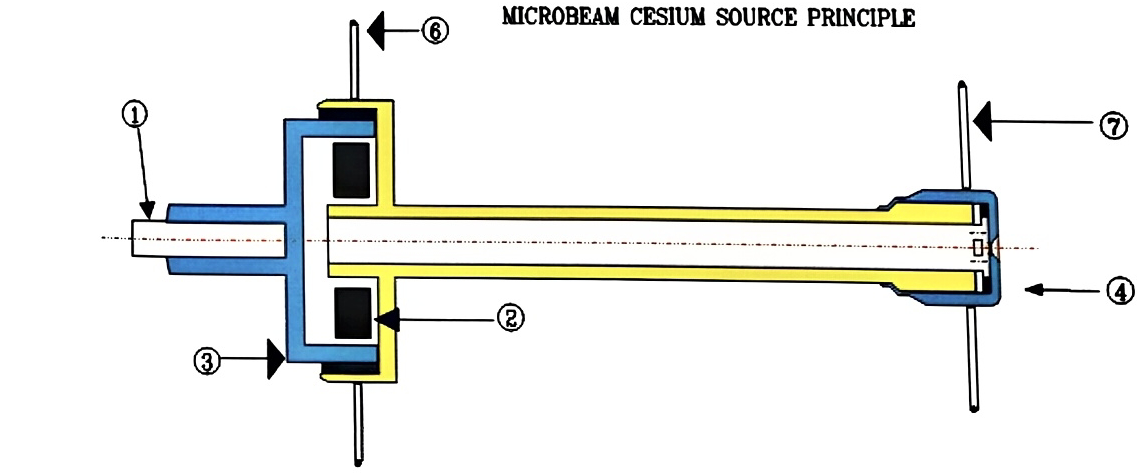
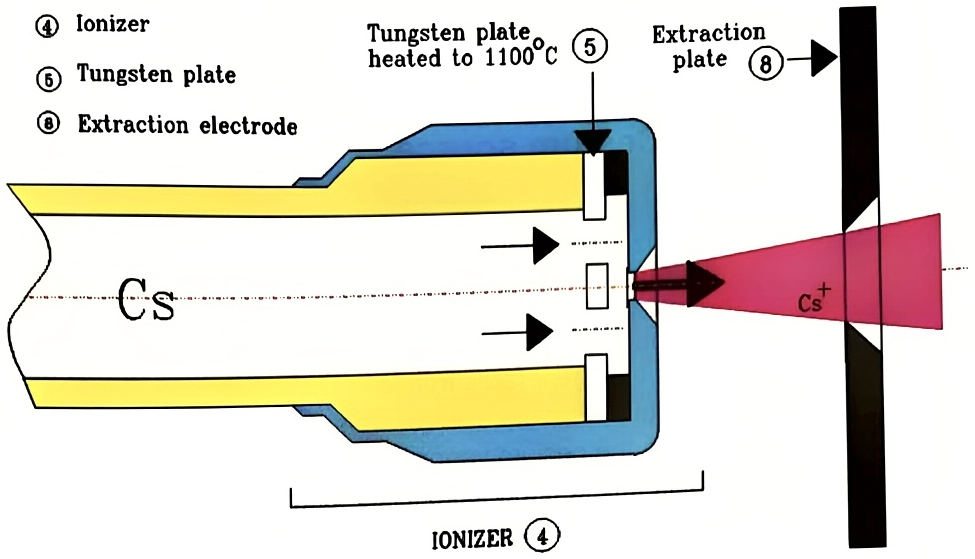
A constant emission of cesium ions is obtained by regulating the heating of the ionizer filament with the electron current between the ionizer and its associated filament ( IION ). In the same manner, the heating of the reservoir filament is regulated with the total current delivered by the extraction of the HV supply ( ITOTAL regulates IRES ).
(ITOTAL = IRES. + IION. + IBEAM + ILeakage)
Note: ILeakage , negligible during normal operating conditions, may be important during a runaway (first usage of an outgassing source); however, a security is designed to limit the over-heating of the source.