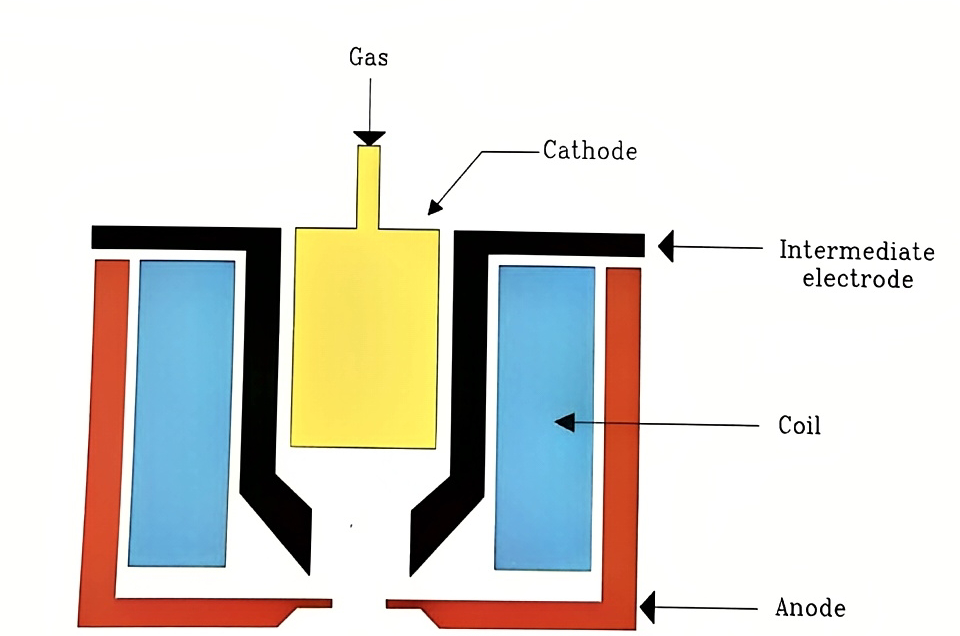
10.1 Principle of the Duoplasmatron source
A gas is introduced at low pressure to the interior of the hollow cathode through an adjustable leak. Plasma is produced by an arc maintained between the hollow cathode and anode which is kept at several hundred volts relative to the cathode. The discharge is maintained close to the axis by a conical intermediate electrode at a floating potential.
A magnetic field produced between the intermediate electrode and anode by a coil concentrates the plasma close to the extraction hole on the anode (the diameter is 400 μm ). A part of the plasma passes through this opening and expands in a chamber due to the pressure difference between the duoplasmatron and the chamber of the gun.
The duoplasmatron can furnish positive or negative ions according to the polarity of the extraction potential. For obtaining negative ions the axis of discharge should be displaced relative to the positive ion extraction. This decentralization permits extraction of negative ions, which are concentrated in the periphery of the plasma and to avoid a strong electron flow which would be produced if the source remained centered. In practice, this is done by decentralizing the intermediate electrode relative to the anode by approximately 0.8mm. Practically, turn the button up to the mechanical limit (clockwise or reverse) and turn back of some 270°.
The gas species generally used are Ar and O. Argon produces Ar⁺ . Oxygen produces positive or negative ions. For positive ions, the beam is composed of O₂⁺ and O⁺ . The abundance ratio O₂⁺/O⁺ is approximately 10. For negative ions, the beam is composed of O⁻ and O₂⁻ . In this case, the abundance ratio is reversed, i.e., O₂⁻/O⁻=1/4 .