12.1 Varying the primary current
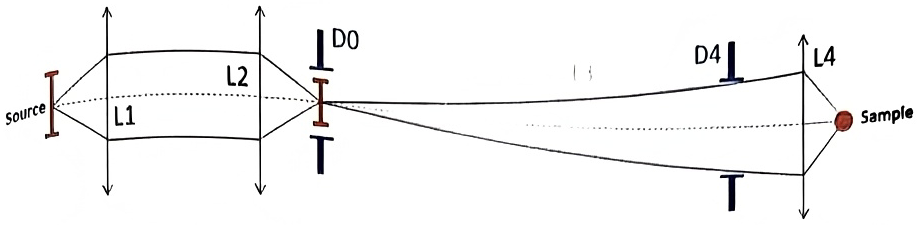
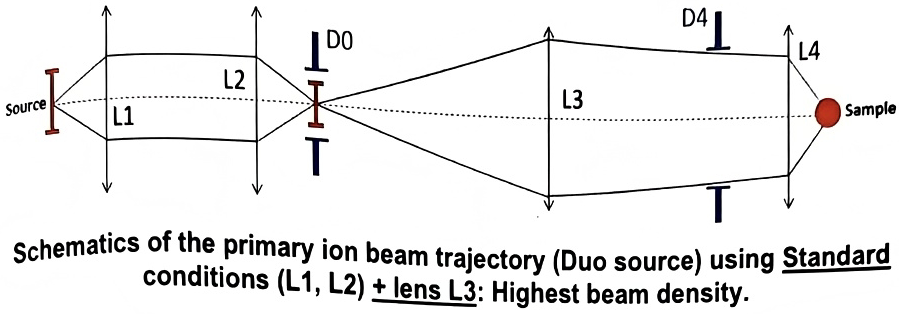
It is advised to use different primary settings (L1, L2 and L3 lenses), for covering different primary current ranges.
| L1 | Fixed about 55% of Duo Source HV |
| L2 | Used to increase/decrease the primary beam intensity (standard beam) |
| L3 | 0 to 40% of Duo Source HV for high beam density if require. Over 65% of Duo Source HV for small beam with high density. (Imaging beam) |
O₂⁺ primary ions, Source HV = +15kV:
12.1.1 For Standard beam:
Section titled “12.1.1 For Standard beam:”Within a given range, the primary beam intensity can be varied through:
- Aperture selection: a smaller D0 aperture reduces both the current and the beam size. A smaller D4 aperture reduces mostly current, but not significantly the beam size. Therefore, it is advised to use mostly the D4 and L2 for changing the primary current.
- Using Lens L3:
○ Low values (usual conditions): L3 values remain to 0, can be increase up to 30% for very high-density beams.
○ High values (to be used only when very small spot diameter is required): the primary beam intensity (but also the beam size) increases with L3.
Note: L3 should not be used between 30% and 60% of the source HV, in order to keep a well-focused primary beam.
In general, the following rules apply for changing the primary current:
- For decreasing the primary beam intensity, do by order until obtaining the requested primary current: increase first L2 (if L3 is not set to 0 decrease L3 value), then decrease D4 and finally decrease D0.
- For increasing the primary beam intensity: do by order until obtaining the requested primary current: increase D4 (if D4 is smaller than 750μm), increase then D0 (if D0 is smaller than 750μm), and finally decrease L2 to 50% of the source voltage and increase L3 (by keeping L3< 30% of the source HV).
Note that changing the aperture selection changes the primary current by discrete steps, while the L2 lens provides a continuous variation. Therefore, the aperture selection and L2 value may need to be combined if a precise primary current value is requested.
12.1.2 For very small beam setting
Section titled “12.1.2 For very small beam setting”For very small beam setting (beam diameter < few μ ms), the following conditions must be selected: high source HV (typically ≥ 10kV), small D0 (typically 400 μ m and under) and D4 (typically 100 μ m), combined with high L2 value (typically above 70% of the source HV). The primary current (and beam diameter) is reduced by increasing L2 value.
O₂⁺ primary ions, Source HV = +15kV: